

High-Speed Rail Project In India
High-Speed rail in India
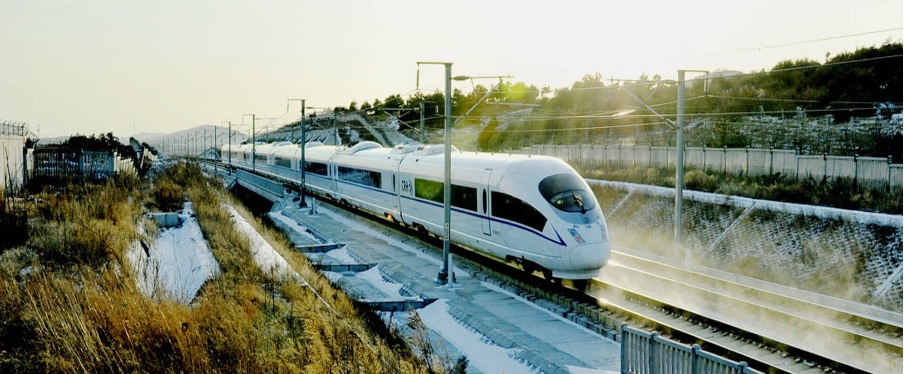
As of 2025, India does not have any operational high-speed rail lines capable of supporting more than 200 km/h (125 mph). Currently, the highest speed is achieved by the Bhopal Shatabdi Express, Gatiman Express, Bhopal Vande Bharat Express and Khajuraho Vande Bharat Express on the Tughlakabad–Agra section and the regional Namo Bharat services with peak operational speed of 160 km/h (100 mph).
Indian Railways operates India's railway system and comes under the purview of the Ministry of Railways of Government of India. As of 2023, it maintains over 108,706 km (67,547 mi) of tracks and operates over 13,000 trains daily. According to the Ministry of Railways, a route capable of supporting trains operating at more than 160 km/h (100 mph) is considered as a higher speed or semi-high speed rail line.
Earlier steam locomotive operated trains largely operated below 100 km/h (62 mph). With the introduction of electric locomotives in the later 1920s and newer steam locomotives, speeds of 100 km/h (62 mph) were achieved. With the movement to AC traction in the late 1950s and introduction of diesel locomotives, commercial speeds of up to 120 km/h (75 mph) was achieved in the late 1960s. With the introduction of high-power electric locomotives in the 1990s, operating speeds of 130 km/h (81 mph) was achieved with further developments leading to speeds of maximum speeds of 160 km/h (100 mph) being realized in the early 2010s. Vande Bharat, an Electric Multiple Unit (EMU), introduced in 2018, is the fastest operational train-set and is capable of reaching 183 km/h (114 mph).
Prime ministers of India and Japan at ground breaking ceremony of Mumbai-Ahmedabad high-speed line on 14 September 2017. A Modified E5 series Shinkansen, that was originally agreed to be purchased by India, can be seen in the backdrop.
The first high-speed railway corridor between Mumbai and Ahmedabad of about 508 km (316 mi) is currently under construction with a designed maximum operational speed of 350 km/h (220 mph) and is expected to be operational fully by 2028-29. As of 2023, eight such corridors have also been proposed.
High-speed rail lines in India
| Corridor | Speed | Length | Gauge | Status | Year |
|---|---|---|---|---|---|
| Mumbai–Ahmedabad | 320 km/h (200 mph) | 508.18 km (315.77 mi) | Standard | Under Construction | 2028 |
| Delhi–Ahmedabad | 320 km/h (200 mph) | 886 km (551 mi) | Awaiting Approval | 2031 | |
| Pune–Nashik | 200 km/h (125 mph) | 235.15 km (146.12 mi) | Awaiting Approval | TBD | |
| Mumbai–Hyderabad | 350 km/h (220 mph) | 711 km (442 mi) | Awaiting Approval | 2051 | |
| Mumbai–Nagpur | 320 km/h (200 mph) | 736 km (457 mi) | Awaiting Approval | 2051 | |
| Thiruvananthapuram–Kasaragod | 200 km/h (125 mph) | 529.45 km (328.98 mi) | Awaiting Approval | TBD | |
| Delhi-Varanasi | 320 km/h (200 mph) | 865 km (537 mi) | DPR Prepared | 2041 | |
| Varanasi–Howrah | 320 km/h (200 mph) | 711 km (442 mi) | DPR under preparation | 2031 | |
| Delhi–Amritsar | 320 km/h (200 mph) | 480 km (300 mi) | DPR under preparation | 2051 | |
| Chennai–Mysuru | 320 km/h (200 mph) | 435 km (270 mi) | DPR under preparation | 2051 | |
| Chennai–Hyderabd | 350 | ||||
| Chennai–Hyderabad | 350 km/h (220 mph) | 744.57 km (462.65 mi) | DPR under preparation | TBD | |
| Hyderabad–Bengaluru | 320 km/h (200 mph) | 618 km (384 mi) | Proposed | 2041 | |
| Nagpur-Varanasi | 320 km/h (200 mph) | 855 km (531 mi) | Proposed | 2041 | |
| Amritsar–Jammu | 320 km/h (200 mph) | 190 km (120 mi) | Proposed | 2051 | |
| Patna–Guwahati | 320 km/h (200 mph) | 850 km (530 mi) | Proposed | 2051 | |
| Ahmedabad–Rajkot | 220 km/h (140 mph) | 225 km (140 mi) | Proposed | TBD |
Diamond Quadrilateral
In 2014, the Diamond Quadrilateral high-speed rail network project was launched by Government of India and is envisioned to connect the four major metro cities of India namely: Chennai, Delhi, Kolkata and Mumbai.
| Corridor | Speed | Length | Status | Year |
|---|---|---|---|---|
| Delhi–Kolkata | 320 km/h (200 mph) | 1,576 km (979 mi) | DPR under preparation | 2031 |
| Kolkata–Chennai | 320 km/h (200 mph) | 1,500 km (930 mi) | TBD | TBD |
| Mumbai–Chennai | 320 km/h (200 mph) | 1,200 km (750 mi) | TBD | TBD |
| Delhi–Mumbai | 320 km/h (200 mph) | 1,394 km (866 mi) | Under construction | 2031 |
| Delhi–Chennai | 320 km/h (200 mph) | 1,900 km (1,200 mi) | TBD | TBD |
| Mumbai–Kolkata | 320 km/h (200 mph) | 1,800 km (1,100 mi) | TBD | TBD |
Super high-speed rail
In 2016, Indian Railways explored the possibility of maglev trains to implement an over-500-kilometre-per-hour (310 mph) speed rail system. In February 2019, a train model based upon the same was unveiled by Raja Ramanna Centre for Advanced Technology capable of speeds of up to 600 km/h (370 mph). In September 2020, Bharat Heavy Electricals Limited signed a pact with SwissRapide AG for the implementation of MagLev metro systems in India.
While there are no operational hyperloop systems in the world, testing has been done and a few routes have been proposed. Hyperloop One submitted a detailed project report in January 2018 for Mumbai to Pune. Virgin Hyperloop signed a MoU with Government of Punjab in 2019 for building a rail to cover total 226 km (140 mi) distance between Amritsar and Chandigarh. Hyperloop One signed a MoU with Government of Karnataka to conduct a feasibility study on the Bengaluru-Chennai route in 2017. Zeleros proposed a vision for a hyperloop network in India by 2050, connecting main cities.